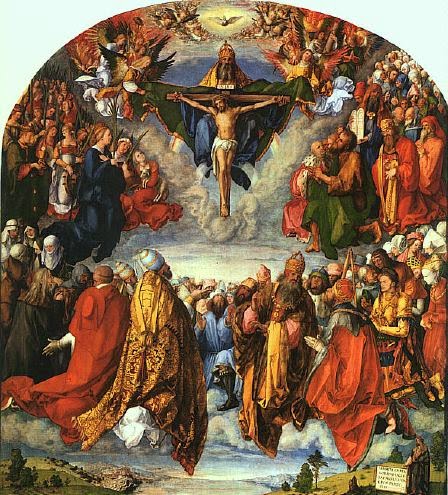
Showing posts with label Hell. Show all posts

Saturday, 1 August 2015

Purgatory, By The Rev. M. Canty, P.P., Part 25.

DOGMATIC AND SCHOLASTIC - THE VARIOUS QUESTIONS CONNECTED WITH IT CONSIDERED AND PROVED.


CHAPTER XIII. THE PLACE WHERE PURGATORY IS. Part 9.

III. The Limbus of infants who die without baptism is subterranean, or under the earth.

This is shown, in the first place, from St. Augustine. (Lib. 4, de Baptismo, cap. 2.) This holy Doctor teaches that there are only two places in which souls shall for ever be. One is heaven ; the other is hell. He recognises no other perpetual receptacle or abode for souls in the other life, but these two. As infants who die in original sin cannot go to heaven, they must, in the opinion of St. Augustine, go to hell. Hence their Limbus, if not the Limbus of the damned, is so near this, that St. Augustine considers it one place with, or a portion of it. But the Limbus of the damned, as we shall soon see, is under the earth. Therefore the Limbus of infants which is near to, or a portion of that of the damned, is likewise under the earth.

In the second place, the Limbus of infants is shown to be under the earth from the Council of Florence. In the last session of this Council, it is denied " that the souls of those who depart in deadly sin, actual or original, presently descend info hell to be punished however with unequal pains." Then the Council defines that those who die in original sin descend into hell. This hell, we shall see, is under the earth. So, as a conclusion from the definition of the Council of Florence, we should hold that the Limbus of infants who die in original sin is also under the earth.

However, the more common opinion in the schools would tell us that the Limbus, in which unbaptised infants are imprisoned, is higher up than Purgatory. It is so high above the latter place, that the fire does not reach it. Thus, if we are to believe those who hold this opinion, the infants who die without baptism have not to endure the fire of hell nor suffer the pain of sense at all. Then their only pain would be that of loss.

IV. The place or hell of the damned is under the earth.

1. The first proof to show that hell is under the earth is found in those phrases or terms, which the Scripture uses when speaking of it. The inspired Word everywhere calls the seat of the reprobate a " stove of fire," a "pool of fire and sulphur," an "abyss," a "well," a " pit," the "depth of the pit," or a " gulf." We cannot understand the grave by such terms as these, which have been never used to designate the place where the body is deposited after death. They indicate a hidden place in the depth of the earth, far removed from the reach and power of man in his present state, or while he is in this life. We read in the Gospel of St. Luke, (viii. 31.) that when Jesus Christ expelled the demons from the possessed man, they entreated Him not to cast them into the abyss: "And they besought Him that He would not command them to go into the abyss." This " abyss " cannot mean the grave. The demons did not entreat, not to be cast into the grave. To be transferred there would be no punishment to them. They had no more to suffer in the grave than in the body of the demoniac. Graves, moreover, are not made for demons, but for human bodies. Thus, there is no reason why the expelled demons should ask not to be commanded to go into the grave. Then the place they feared was some place into which they naturally expected to be cast—some place that had been prepared for them.

2. The very name of hell, which is found in the Hebrew, Greek, and Latin texts of the Scripture, proves it to be under the earth. It signifies not the grave, but a place far below us. It denotes the lowest place, in opposition to heaven, which is the highest. This opposition the Psalmist (cxxxviii. 8.) sang thus: " If I ascend into heaven, thou art there: if I descend into hell, thou art present." In like manner we read in Job xi. 8: "He is higher than heaven, and what wilt thou do ? He is deeper than hell, and how wilt thou know?" In Isaias xiv. 14-15 also it is written: "I will ascend above the height of the clouds. Thou shalt be brought down to hell, into the depths of the pit" And our Divine Lord says, in the Gospel of St. Matthew  xi. 23. "Thou Capharnaum, shalt thou be exalted up to heaven? thou shalt go down even unto hell." In each and all these passages, there is an anti thesis, or contrast, set up between heaven and hell. While heaven is in the highest place over us, hell is in the lowest place under us, in the universe. The contrast which is put forth between heaven, which is at such a distance above us, and hell, shows that the latter word cannot mean the grave, which is only a few feet below us, and is oftentimes even over the earth, as in the case of vaults, or raised sepulchres. This was especially the case in the time of Jesus Christ, when it was the custom to bury the bodies, not in the ground itself, but in caves which were raised over, or upon it. What would be the reason, then, of the contrast between heaven, which is the highest place above us, and the grave, which is on a level with, or at most, a few feet under us. There fore hell, in the above passages, must refer not to the grave, but to a place which is far lower in the earth, and where the damned dwell.

3. In the Gospel of St. Luke  xvi. 22., it is said of the rich man, that "he was buried in hell;" and, it is added, that " he was in torments." Now, " hell," in this place, cannot by any process of reasoning, nor even by cavilling, be construed so as to mean, or be equivalent to, the grave. That rich and wicked man was not tormented in the grave, where no one suffers torment, unless we be so simple as to say that the soul and body are buried together. This rich man who " was buried in hell," according to the words of our Lord in the Gospel, cried out: " I am tormented in this flame." Surely this "flame," in which he was so tormented, was not in the grave, but in a place far lower down in the earth, in the hell of the damned.

4. The writings of the Fathers bear testimony to the subterranean situation of hell. Arnobius, (Lib. 2, contra gentes, de Platone.) speaking of the reprobate, says; "One does not improperly suspect that those souls lie amidst rapid rivers, which are hideous with balls of flames and filthy whirlpools." His words are undeniable evidence that Arnobius did not confound the locality of hell with the grave. Tertullian (Apolog. 47.) openly calls hell " the subterranean treasure of hidden fire." This cannot apply to the grave, where there is no fire, open or secret. This treasure of fire, then, must be buried deep in the interior of the earth, a place to which we, while in this life, have no access. St. Jerome (In cap 14 Isaiae.) describes the situation of hell as distinctly as words could describe it at the present day. He writes with terseness and succinctness: " We say that hell is under the earth." Such is the conviction of St. Jerome, the prince of biblical scholars and interpreters, regarding the situation of hell. St. Augustine, (Lib. Retractat., cap. 24) St. Gregory, (Lib. 4, Dialog., cap. 42.) Ven. Bede, and other Fathers, agree with those just quoted.

5. Reason itself would insinuate that hell is under the earth. If heaven is in the highest, hell should be in the lowest place. As the seat of those who subdued their passions and overcame the love of the world, is the highest, so the seat of those who gave a loose rein to their passions and cherished the love of the world should be the lowest. This is in conformity with those words which we read in the Book of Proverbs xv. 24. "The path of life is above for the wise, that he may decline from the lowest hell." Thus, while the wise or the just have their eternal abode above, they have escaped the lowest hell, or that hell which is in the lowest place.

Saturday, 23 May 2015

An Eternity of Heaven Or Hell. Part 3, By Rev. Clement Henry Crock. “MAN SHALL GO INTO THE HOUSE OF HIS ETERNITY” -ECCLES. 12:5.


Now let us analyze the MEANING OF THE BEATIFIC VISION. It is composed of three Latin words, namely, “beatus,” happy; “facio,” I make; and “visio,” sight; all of which taken together may be translated as a HAPPY-MAKING SIGHT. Therefore, Beatific Vision means a sight which contains in itself the power to banish all pain, all sorrow from the beholder, and to infuse, in their stead, joy and happiness. Then, considering it as a perfect and permanent state, the Beatific Vision consists in three acts which are essential to its integrity and perfection. These are:

(1) the sight or vision of God; (2) the love of God; and (3) the enjoyment of God. These three acts, while distinct from each other, are inseparable; for, by excluding any one of these, the Beatific Vision no longer exists in its integrity.

Let us explain: (1) The greatest and most essential joy of the Blessed consists in the VISION OF GOD, seeing Him face to face, and the enjoyment of His infinite beauty. “Blessed are the clean of heart, for they shall see God” (Matthew 5, 8). On this earth there is nothing even remotely comparable to this vision. “We see now,” says Saint Paul, “through a glass in a dark manner, but then face to face.” This sight or vision of God is attained, not by the eyes of the body, but through the intellect- the noblest faculty of the soul- which is suddenly elevated by the light of glory, and enabled to see God as He is by a clear and unclouded perception of His divine essence. We shall then see and understand God in the Most Holy Trinity—the infinitely powerful Father Who created us, the infinitely wise Son Who redeemed us, and the infinitely good Holy Ghost who sanctified us.

“He will all glory, all perfection be,
God in Union, and the Trinity!
That holy, great, and glorious mystery,
Will there revealed be in majesty,
By light and comfort of spiritual grace;
The vision of our Saviour face to face,
In his humanity; to hear him preach
The price of our redemption, and to teach
Through his inherent righteousness in death,
The safety of our souls and forfeit breath!
What fulness of beatitude is here!
With love with mercy mixed doth appear!”

(2) The last line indicates the second act on the part of the soul in order to complete the Beatific Vision. It is an act of perfect and inexpressible love, because it is impossible for the soul to see God in His heavenly beauty, goodness, and unspeakable love for us, without loving Him with all the power of our being in return.

“What love with mercy mixed doth appear!
To style us friend, who were by nature foes!
Adopt us heirs by grace, who were of those
Had lost ourselves; and prodigally spent
Our native portions and possessed rent!
Yet have all debts forgiven us! and advance
By imputed right to an inheritance
In his eternal kingdom, where we sit,
Equal with angels, and coheirs of it.”

Although the tongue of man is powerless to describe adequately so great a wonder, this blending together of the human and divine love, yet, we see some image of it in sensible, or visible objects. In nature, the stronger always attracts the weaker. Thus the grey iron that is placed in the fire takes in heaven shall be so inflamed with the fire on the appearance of fire. So also the Blessed of God’s love, that, although their nature remains unchanged, they will differ from those on earth as fire at white heat from the frozen clod.

(3) With the seeing of God face to face, with this intense love that arises through the Beatific Vision, there follows the third act, namely, that indescribable joy which proceeds spontaneously from both the vision and the love of God. “There all the happy souls that ever were,
Shall meet with gladness in one theatre;
And each shall know there one another’s face,
By beatific virtue of the place.
There shall the brother with the sister walk,
And sons and daughters with their parents talk;
But all of God: they still shall have to say,
But make him all in all their theme that day;
That happy day that never shall see night!
Where he will be all beauty to the sight.”

We know even now what joy comes to us when we are in the company of friends we love. If the Saints could faint away from the love of God they already experienced here on earth, what must be their rapturous love when, wrapt in God’s loving embrace, they gaze upon Him as He is! The Beatific Vision, then, is what makes heaven for the soul. But it is only the beginning of our heavenly happiness; for, we shall not only see God, the source of all loveliness; we shall not only possess God, the source of all goodness; we shall not only love God, the source of all delight; but we shall become like to Him, says Saint John (I John 3, 2). “We know that, when he appears, we shall be like to Him, for we shall see Him, just as He is.”
With Ecclesiastical Approval.
********

Friday, 22 May 2015

An Eternity of Heaven Or Hell. Part 2, By Rev. Clement Henry Crock. “MAN SHALL GO INTO THE HOUSE OF HIS ETERNITY” -ECCLES. 12:5.


What are the pains of hell? They are both positive and negative. The positive suffering in hell is that of pain. This we can readily understand here on earth, being, as we are, surrounded by so much suffering. But perhaps the greatest suffering in hell is that of loss, which we can less readily understand. The latter suffering of loss, I would rather stress as the greater by far of the sufferings endured by the damned. Nothing hurts a child more than to hear from an angry parent the words: “Depart from me!” “Get out of our house!” A soul that is lost will be deprived forever of the happiness of seeing God face to face. To its eternal regret, the lost soul will realise that, through its own fault, it has forfeited the greatest of all blessings and missed the very purpose of its existence here on earth, namely, one day to enjoy the Beatific Vision.
Here is how Saint John Chrysostom describes this pain of loss: “The fire of hell is insupportable—who does not know it? and its torments are awful. But if you were to heap a thousand hell-fires one on top of the other, it would be as nothing compared to the punishment that consists in being excluded from the beatific glory of heaven, hated by Christ, and compelled to hear Him say: “I know thee not”.” All former love between friends on earth now turns into hate; only curses, complaints, accusations, weeping, and gnashing of teeth remain. No kind or friendly word between former friends will ever fall on their ears, nothing but groans, curses, and shrieks, to which they will add their own lamentations and unavailing regrets.

Do you wish to avoid such an eternal calamity? Here is the admonition of Saint Bernard: “Descend into hell during life, that you may not descend after death.” We will then work out our salvation in fear and trembling. Many who are Saints in heaven today would never have persevered in virtue, except for the fear of hell. And if the thought of a loving and merciful God can no longer move us to do good and avoid evil, then let us, with filial fear, turn to the God of Justice and pray with the Psalmist: “Pierce Thou my flesh with Thy fear, for I am afraid of Thy judgments” (Ps. 118, 12).
* * *

“Eye has not seen, nor ear heard, neither has i t entered into the heart of man, what things God has prepared for those who love Him” I Cor 2, 9.
As we approach the twilight of life all agree that life on earth, even at its best, is an unsatisfying thing. “Within each spirit’s hidden depths
Some sweet hope withered lies,
From whose soft, faded bloom we turn
In sadness to the skies.”

Yes, no matter how numerous our successes, no matter how extensive the acquisition of our knowledge, no matter how great our wealth or physical comforts we may acquire and enjoy along life’s way, we are ever conscious of desires and yearnings that nothing on earth can satisfy. This human trait manifests itself already in early childhood, accompanies us through youth to old age, and terminates only at the grave with death.
Some have sought to satisfy these desires in creatures. Such people are sadly disillusioned through life, and especially at death. With a belated remorse such people then realise that we are destined for something incomparably better than anything this world can offer. For, as the Author of nature, God has endowed the soul of every man with an innate and fixed propensity, namely, a desire for the good, the beautiful, and the true; nay more, for the perfectly good, the perfectly beautiful, and the absolute true. The purpose of this continual restlessness is to lead us ultimately back to God, to heaven. Saint Augustine expressed it when he exclaimed: “O Lord, our hearts are restless until they rest in Thee!”

And to this natural propensity, God has further added the supernatural gift of faith through Baptism, giving us added knowledge of God and divine things; guiding us, if we follow His teachings and carry out His precepts, to the ultimate fulfilment of our exalted desires and aspirations. Then, in order to encourage us in our struggles and sorrows, Jesus has given us reminders of the brevity of our earthly pilgrimage, and promises of rewards exceedingly great if we persevere faithfully to the end. “Your reward,” He assures us, “is very great in heaven” (Matthew 5, 12). Again, “be thou faithful until death, and I will give thee the crown of life” (Apoc. 2, 10). This leads Saint Paul to exclaim: “I reckon that the sufferings of the present time are not worthy to be compared with the glory to come” (Rom. 8, 18).
This brings us to the question: What is heaven? Words fail us when we attempt to define what heaven is; our efforts are but feeble attempts to describe heaven adequately. In general, and by way of analogy, heaven has been described as “the accomplishment of all the desires of God, of creatures, and of man; as the restoration of all things into a state of absolute perfection; as the eternal repose of quiet and order.” Saint Thomas indicates that even the earth and its elements will be changed to serve the elect. The water shall then be crystal-clear; the air pure as the clearest sky; fire as bright as the sun and the stars; and the surface of the earth as transparent as glass, with a sweet unchanging temperature. Saint John pictures heaven with its gates of pearl, its streets of pure gold, its foundations of all precious stones, its light of the glory of God (Apoc. 21, 19–23). Yet, all these are mere wordpictures, in no way pretending to describe the real beauty of God’s house.

AS FOR GOD, we may describe heaven as the full enjoyment of all His works; the manifestation of His glory, power, goodness, wisdom, and all His other perfections or attributes; the loving intercourse and companionship of a fond Father with His affectionate children; the immense, eternal, overflowing love of creatures for God. AS FOR MAN, every creature will retain his own individuality, but will form a union with God so intimate that everyone will enjoy an ocean of unspeakable delights and the plenitude of his being. In heaven man will realise the accomplishment of all his legitimate desires. This comprises two things, namely freedom from all evil, and perfect possession of all good.

The negative side of heavenly happiness, namely, freedom from all evil, can be more readily understood by us mortals, because of our daily experiences. Life as a whole is often spoken of as “a vale of tears,” both for body and soul; the spirit constantly in conflict with the flesh. “We have passions that tyrannize over us, thoughts that trouble us, desires that torment us, remorse for the past, disgust of the present, solicitude for the future, weariness, bitterness, agitation.” As for the body, we are constantly plagued with pain, toil, fatigue, infirmity, disease, poverty, disaster, reverses of fortune- an unending series of evils without end. In heaven these body afflictions will cease, never to return. “God will wipe away,” says Holy Writ, “every tear from their eyes. And death will be no more; neither shall there be mourning, nor crying, nor pain anymore, for the former things have passed away” (Apoc. 21, 4). If heaven were nothing more than this, that in itself would be a blessing without comparison to anything we know of here on earth. Yet, this is only a small portion of what heaven really is, and as we unfold these heavenly beauties one by one, the words of Saint Paul will become an eternal reality when he tells us that “eye hath not seen, nor ear heard, neither has it entered into the heart of man, what things God has prepared for those who love him” (I Cor. 2, 9).
* *
“We see now through a glass in a dark manner, but then face to face” I Cor. 13, 12.
Let us never lose sight of the fact that, by God’s eternal decree, heaven is our goal, heaven is man’s destiny. Reason, revelation, and the experience of more than six thousand years unite in the one proclamation that perfect happiness cannot be found in this world. It certainly cannot be found in creatures, because they were not endowed with the powers to bestow it. Perfect happiness cannot be found even in the practice of virtue, because God, in His wisdom, has decreed that virtue should merit, but never impart perfect happiness in this world. But God has solemnly pledged to bestow “eternal life” upon all who love and serve Him here on earth. He has promised a happiness so unspeakably great that it will surpass all that our senses ever enjoyed here on earth.

From what has been revealed to us, this happiness in heaven falls into two categories, namely, the primary and the secondary happiness. The primary, or SUPREME HAPPINESS in heaven, consists in seeing God “face to face.” It consists in the possession and enjoyment of God Himself in the BEATIFIC VISION which bestows perfect satisfaction on every rational craving of our nature in the glorious resurrection of the body.

An admonition is in place here; namely, that we must guard against certain mistakes when speaking of the joys of heaven. We are very apt to build up a heaven of our own, which naturally takes the shape and colour which our sorrows, needs, and sufferings might suggest. The poor man, for example, who has suffered much from toil and want, may look upon heaven as a place of rest, abounding in all that can satisfy the cravings of nature. Another, who has endured the pangs of disease, may look upon heaven as a place where he will enjoy perpetual health of body and mind. Still another, who, in the practice of virue, has had all manner of temptations to overcome, may delight in viewing heaven as a place totally free from temptation where even the possibility of sin will be excluded. All these things, with many other pleasures that come from creatures, are, to be sure, a portion of our heavenly joys; but they are accidental, or secondary joys, that accompany the essential and primary happiness which the soul receives immediately from God in the Beatific Vision.
This distinction is so important that we might make it more understandable with an illustration. A man, for example, is gifted with perfect health of body and mind. He not only enjoys life itself, but likewise receives much pleasure from the beauties of nature, from literature, amusements, and society. Now suppose that he loses his health, and sickness lays him low. He is no longer able to enjoy either life itself, or its pleasures, because, with the loss of health, he has lost also the powers of appropriating the secondary pleasures of life; for this man, then, health is essential for the enjoyment of life, while the relish of other pleasures is secondary. So, too, in heaven: the Beatific Vision is essential, not only to enjoy the very life of heaven, but likewise to enjoy the accidental or secondary glory wherewith God perfects and completes the happiness of His elect.

Thursday, 21 May 2015

An Eternity of Heaven Or Hell. Part 1, By Rev. Clement Henry Crock. “MAN SHALL GO INTO THE HOUSE OF HIS ETERNITY” -ECCLES. 12:5.


We have arrived at the stage of life when we must realise that the hour-glass is rapidly running out, that the pendulum of life is coming to a stand still, and that time will soon be no more. With death an eternity without end begins. Every year, on Ash Wednesday, the Church solemnly reminds us of these eternal truths. With the inauguration of the Lenten season, the priest places blessed ashes upon our forehead in the form of a cross, saying:”Memento homo quia pulvis es, et in pulverem reverteris.” “Remember man that thou art dust, and into dust thou shalt return” (Gen. 3, 19). The ashes are intended to remind us of our own mortality when our bodies will return to dust whence they came. The cross upon our foreheads reminds us of our immortality; that while the body dies, the soul does not die; that through the Cross of Christ our redemption was purchased. In the words of the poet, Longfellow, the Church wishes to remind us that “Life is real! Life is earnest! And the grave is not its goal; Dust thou art,to dust returnest, Was not spoken of the soul.”
While many have tried to explain the meaning of eternity, no one has ever succeded in defining the word adequately. “Whatever you say of eternity,” says Saint Augustine, “you will fall far short of the subject. It is impossible for our weak intelligence to form an absolutely clear conception of eternity.” Some have compared the word with things we know. Boetius, for example, tells us “eternity is the complete possession of a life that has no end.” Saint Bernard calls it “a condition comprising in itself all times, the present, past and the future.” Saint Gregory says, “eternity is one long day, never followed by night.” Some have compared eternity with the sands on the sea shore, drops of water in all the oceans of the world, or the multiple letters in the books that have ever been printed. But in the fanciful flight of our imagination we might still look forward to a time when every grain of sand might be counted, every drop in the oceans or letters in all the books accounted for, and yet, when all that is accomplished we would still be forced to say that eternity had just begun.
This is the eternity that confronts us at death. From the moment you and I were born into the world, each of us was started on the road to eternity. Mark the words of Holy Writ, saying, “Man shall go into the house of HIS eternity” (Eccles. 13, 5). Note the words, “his eternity!” Your eternity, my eternity, because everyone prepares his own eternity. The Creator has endowed us with understanding and free will. The choosing is ours to determine what kind of an eternity awaits us. The difference lies between sinner and saint. In Christ’s own words, the former will be greeted with the words: “Come, ye blessed of my Father, possess you the kingdom prepared for you”; the latter with the words: “Depart from me, ye cursed, into everlasting fire” (Matt. 25, 34–41).
Proper reflection upon these words and what kind of eternity might await them, led many people to alter the course of their lives and prepare for a happy eternity. Ask the Saints of God who have gone before us and are now enjoying their eternal reward in heaven at this moment what prompted them to lead heroic lives. It was the thought of eternity that made Saint Stephen remain steadfast in his martyrdom, that sustained Saint Lawrence and rendered endurable his death in the flames; that made St. Augustine desire only crosses and suffering in this life and led him to exclaim: “Here burn, here cut, O Lord, but spare me in eternity.”
After so many of our patriotic men and women had faced death on the far-flung battle fronts during the last World War, many others returned and sought seclusion in prayer and contemplation behind cloister and monastery walls. The same thought of eternity prompted kings and emperors to relinquish their crowns and renounce the world. Pope Celestine V resigned his eminent office in order to lead the life of a hermit. The thought of eternity has prompted untold others to a life of prayer, fasting, study, work and the fulfilment of the duties of a Christian, of one’s state of life, of every kind of penance, of keeping all the Commandments under the stress of temptation and adversity, in every nation and clime down through the centuries. Like Saint Bernard, they look upon life as seeding time and their good deeds as the “seeds of eternity.”
These many cogent facts and examples should prompt us to reflect upon the thought of eternity and prepare for it while it is still time. For,
“Life is short—and death is sure;
The hour of death—remains obscure.
A soul you have- and only one;
If that be lost, all hope is gone.
Waste not your time—while time shall last
For after death “tis ever past.
The all-seeing God your Judge will be—Or heaven or hell, your destiny.
All earthly things will fleet away.
Eternity shall ever stay.”
By remembering this now, then, when our eternity begins, may it be said of each one of us: “Blessed is he that is found without blemish. For he hath done wonderful things in his life. He could have transgressed, and hath not transgressed; and could do evil things, and hath not done them. Who hath been tried thereby and made perfect, he shall have glory everlasting” (Eccles. 31, 8–11).
* * * *
“Then He will say to those on His left hand, “Depart from Me, accursed ones, into the everlasting fire” “ -Matt. 25, 41.
Some years ago the daily newspapers carried a gripping story, captioned with large glaring letters, EXILED. The story described the departure of 670 convicts of the worst type who had been banished from their native land to a penal colony on a small island in the South Atlantic. Hysterical over the prospects before them, these desperados were chained and handcuffed and herded into steel cages in a stinking prison ship on which they were slowly carried out from the harbour of their native land. They were on their way to DeviI”s Island where they faced a cheerless and utterly hopeless future in a tropical heat to which they were not accustomed, and in quarters so restricted as to constitute a prison without walls. There these criminals of the worst type, rascals, murderers, thieves and thugs, were to waste away their lives and die, forgotten by kith and kin as completely as the public forgot them the hour the ship sailed.
These criminals deserved little mercy, but the nature of their punishment is one of the cruelest that can be devised. Some poet has said: “Stone walls do not a prison make, nor iron bars a cage.” It is not so much the physical ordeal confronting such convicts that is so terrible as the hopelessness of their plight, the horrible nostalgia in a far-off and forbidding land, the terrible mental depression which makes the punishment so gruesome. It is the nearest approach to hell itself that man can conceive.
But the word “hell” is no longer a welcome word in polite society. Much less will such tolerate any mention of eternal punishments or of everlasting fire and torments in hell. Now, we wish to frighten nobody. But silence will not extinguish the pains of hell, nor render them non-existent. Were all of us to agree to remain silent on the subject, hell would still continue to exist; for as sure as there is a heaven to hope for, so surely is there a hell to fear. Our Lord told us so, and God cannot deceive. And since this is true, we should think of it and speak of it more frequently; for knowing it, we shall fear it, and fearing it, we shall avoid it. “If those who argue against hell,” says Saint John Chrysostom, “would embrace virtue, they would soon be convinced of its existence.” Hence, like her Divine Founder, our Church teaches there is a hell; that souls there suffer a punishment which will never end; that both body and soul will suffer eternally after the General Judgment; that there is a fire in hell which will last forever; that the damned suffer pain, misery and despair, loss of God, indescribable agony, and unavailing remorse.
Here are some of the reasons for our belief: In the twenty-fifth chapter of Saint Mat thew’s Gospel, our Lord draws a vivid picture of the Last Judgment. All the people of the entire world will be gathered together. The good will be separated from the wicked. The Lord will say to those on His right hand: “Come, ye blessed of my Father, possess you the kingdom prepared for you.” But to those on the left He will say: “Depart from me, you cursed, into everlasting fire, which was prepared for the devil and his angels.” Immediately Christ adds these significant words: “And these shall go to everlasting punishment; but the just into life everlasting.” Saint John (Apoc. 20, 9–10), describes hell in these words: “There came down fire from God out of heaven, and devoured them; and the devil, who seduced them, was cast into a pool of fire and brimstone, where both the beast and the false prophet shall be tormented day and night for ever and ever.”
And Saint Paul is even more specific in singling out those who will not enter into the kingdom of heaven. “Know you not,” he asks, “that the unjust shall not possess the kingdom of God? Be not deceived! Neither fornicators, nor idolators, nor adulterers, nor the effeminate, nor thieves, nor the covetous, nor drunkards, nor railers, nor extortioners, shall possess the kingdom of God” (I Cor. 6, 9–10; Gal. 5, 19). “These words would be untrue,” says Saint Augustine, “if the damned after a length of time, would be set free from hell, if they would yet possess the kingdom of God.” And Saint Gregory adds: “The justice of the Supreme Judge requires that they who in this life would never be without sin, should never be without punishment in the hereafter.” Then Saint Chrysostom argues this way: “All of us, Greeks and Jews, heretics and Christians, acknowledge that God is just. Now, many who sinned have passed away without being punished, while many others who led virtuous lives did not die until they had suffered innumerable tribulations. If God is just, how will He reward the latter and punish the former, unless there be a hell and a resurrection?”
If further proof for the existence of hell is needed, then let us hear from a few pre-Christian and pagan sources. The ancient Greeks believed in their Tartarus. Plato says: “The wicked will be precipitated into Tartarus, never more to come out.” Xenocrates taught that the souls of the wicked wander about in dark places under the earth. Plutarch held that the wicked, after death, are confined in a place that no man can open. The Latin poet, Virgil, in his Aeneid, portrays to us the never-ending sufferings of the damned souls. The Jews compared hell to Gehenna, in a valley near Jerusalem, in which human beings, especially babies, were sacrificed to the god of fire, Moloch. Hence Plato, the poet and philosopher, declares in his Phaedo: “After having maturely weighed all things and tested them severely, I have found nothing that is more compatible with wisdom, reason and truth,” than the belief in hell and its punishments.
There are those who say that such an eternal punishment is unreasonable, altogether out of proportion to a sin committed which takes but a brief moment of time. But such a comparison is not correctly drawn. We must first consider the nature of mortal sin for which hell is the punishment; secondly, the nature of the damned who are undergoing the punishment; and, thirdly, the nature of God Who imposes and enforces the punishment.
No one will go to hell against his will. Only those are there who have died unrepentant, with mortal sins upon their souls. And a mortal sin is a deliberate defiance of God and His laws in grave matter in which the sinner knowingly and deliberately exclaims defiantly: “Non serviam!” “I will not serve!” “Even here on earth,” says Saint Thomas, “the fact that adultery or murder is committed in a moment, does not call for a momentary punishment; in fact, these crimes are sometimes punished by imprisonment or banishment for life, sometimes even by death; this punishment, in its own way, represents the eternity of punishment inflicted by God.” And if the punishment were not eternal, then the worst criminal could for all eternity remain in defiance of God, knowing that in due time the punishment for his crime would cease. Therefore, it is man, not God, who creates an eternal punishment for himself. God merely permits it, in order not to frustrate the free will of man which makes man accountable for his good as well as his evil deeds.

Saturday, 29 October 2011

The Reading of the Scriptures by Fr Felix, O.F.M.Cap.

The study of the Scriptures is pleasant and interesting, but it would be going too far to say that it is easy. They treat of God and the supernatural, we could not expect to grasp the full sense of the Sacred text at a reading. We require help to understand the Bible. Now, the labours of the greatest scholars of the whole Christian era have done much to clarify the meaning of the Scriptures. Sound principles of interpretation have been formulated to guide us in reading; knowledge of these will be of the greatest assistance to us. Again, a general idea of the content of each of the twoTestaments that make up the Bible will be at once an attraction and an aid to the reading and understanding of them. This is true of the classics of ordinary literature; it is no less true of the Bible.
THE INTERPRETATION OF THE SCRIPTURES
St Jerome
THE first rule for the interpretation of Holy Scripture is that the text be read carefully. This may appear self-evident, but at least it requires to be emphasised. Nothing is so important as the reading of the Scripture itself—continuous, assiduous reading, and so far as possible, methodical, systematic reading. An old trite axiom says: "The best commentary on the Bible is the Bible itself." The Bible is an harmonious whole. The books which compose it, though beautifully varied in literary form and style, are one in their principal author,—God; and one in their purpose,—to teach us God. One passage in the Bible will shed light on another, and the study of the text itself is always the first consideration. Again, for the very reason that the Bible is difficult of interpretation the text must be read closely. The same is true of any difficult text. Thus, in the matter of Canon Law, the law of the Church, which requires close study and often a commentary by an expert, the same rule holds good. "Read the Code" is always the advice of professors to students of this subject. This is not to depreciate commentaries. These have their function and value, to be sure; but they are of secondary importance to the reading of the text. A well-known adage of philosophy warns us that "The accessory follows the principal." The commentary is an accessory; the text is the principal. The commentary is a means to an end; the end is the elucidation of the text. This golden rule of reading the text is convincingly established by its success in the case of St. Jerome,* whom the Church, in the prayer for his feast (Roman Breviary, September 30th) calls Her "greatest Doctor in interpreting the Sacred Scriptures." With reference to his stay of three years on the Aventine in Rome, he writes: "I frequently explained to a number of others, as far as I could; the divine books; reading of them had created interest; interest, familiarity; familiarity, confidence." (Epistle 45, 2). Note the sequence—reading, interest, familiarity, confidence; and confidence implies proficiency. * St. Jerome was born about 347 A.D.; died in 420 A,D.
THE ORIENTAL MIND.
The Bible was written in the East, and its idiom and literary form reflect the Oriental mind, and differ widely from our western mode of expression. For one thing, figurative language abounds, especially those four figures of speech which we call respectively the simile, the parable, the metaphor, the allegory. For the easterns, who are a highly imaginative people, these figures are the ordinary mode of conveying ideas; we use them too, but not nearly to the same extent. In any event, they are almost a necessity for bringing home the truths of religion to the ordinary mind. Our knowledge comes to us through the senses, and we think mainly in terms of space and time. A trained philosopher can transcend these limitations and think in the abstract, but trained philosophers are a minority of mankind. Now, the truths which the Bible teaches deal with the spiritual order, with a world not measured in terms of time and space. These figures of speech, therefore, convey the divine message in a manner suited to the capacity of the simplest mind, and at the same time add great literary beauty. A simile is simply a comparison. Thus, Our Lord expressed His solicitude for the people of Jerusalem by comparing it to that instinctive care of the mother hen which gathers her chickens beneath her wings for their comfort and protection: ''Jerusalem, Jerusalem, . . . how often, would 1 have gathered together thy children, as the hen doth gather her chickens under her wings, and thou wouldst not?" (St. Matthew 23, 37). The idea is conveyed all the more forcibly because the Saviour's love is compared with something which is familiar to us, and expressed in terms of what is known to us.
THE PARABLES.
Closely allied to the simile is the parable, which we meet especially in the Gospels where it is so frequently made a vehicle of His teaching by the Son of God. A parable is a sustained or continued simile. The parables of the Gospel are of surpassing beauty, rich in glorious and varied imagery simple, yet profound; abounding in force and divine eloquence—God condescending not only to teach us the truths of eternal life, but further to accommodate that teaching to our limited understanding so that we may be led from the things of sight and sound to the higher truth; of the immaterial order. "The kingdom of heaven is said to be like to things of space in order that the mind may rise from the things which it knows to those which it knows not.'' (St. Gregory, the Great,* Homily II on the Gospels). In all these similes and parables there is first of all the image taken from ordinary human affairs; for instance, the unjust steward of St. Luke 16, 1-9, who, having neglected his employer's interests, is called to account. This must be studied and clearly visualised, to begin with. Secondly, there is the point of comparison,—in every case one particular truth is emphasised, and the comparison is pointed to demonstrate that truth. In this parable of the unjust steward the point of comparison is his sagacity and foresight in making provision for his future by remitting debts due to his master while he still has power to do so; "And the lord commended the unjust steward, forasmuch as he had done wisely" (i.e. prudently). (St. Luke 16, 8). The question of the dishonesty of his action does not enter at all. The only point at issue is the prudence he displays in regard to his future temporal welfare. This then leads on to the third feature of the parable, viz., the spiritual truth to be demonstrated. This is demonstrated in our parable here by force of contrast: "the children of this world are wiser in. their generation than the children of light.." (St. Luke 16, 8). People display keener astuteness in their temporal than in their spiritual affairs.
METAPHOR AND ALLEGORY.
Metaphors are frequent in the Bible, and a metaphor may be described as "a simile with the words of comparison omitted," as, for instance, where Our Lord says: "And why seest thou the Mote that 'is in thy brother's eye; and seest not the beam that is in thy own, eye?" (St. Matthew 7, 3). People who criticise little imperfections in their neighbour's conduct when (as often happens in the case of critics) their own conduct is gravely wrong, are described, as it were concerned about a particle of dust in another's eye and oblivious of the presence in their own of a beam of timber. There is here hyperbole (i.e. exaggeration for rhetorical effect) as well, as again in the description of those "who strain out a gnat and swallow a camel" (St. Matthew 23, 24); this lends additional emphasis. The allegory bears the same relation to the metaphor as the parable does to the simile—it is a sustained metaphor. Thus, the necessity of Divine Grace is forcibly taught in the Gospel passage where Our Lord says: "I am the true vine; and My Father is the husbandman,. . . Abide in Me, and I in you. As the branch cannot bear fruit of itself, unless it abide in the vine, so neither can you, unless you abide in Me. . . . Without Me you can do nothing" (St. John 15,1-5). These four figures of speech are all closely related. To understand one is to understand all. Then, that done, we have already acquired much that will help us to understand the doctrine and to appreciate the literary charm of the Scriptures generally, and of the Gospels in particular.
THE CONTEXT.
After the text, the matter next in importance is the context, i.e., the part of the book before and after a particular passage. This gives us the general trend of the sense. Many difficulties which arise will be resolved by reconsidering a text in the light of the general argument, or theme of the chapter or book. And many of the objections which are urged against Catholic doctrine are simple instances of texts of Scripture arbitrarily wrenched from their context and then given a meaning which they do not bear in the Scripture itself. Even already in apostolic times there were "the unlearned and unstable" who similarly "wrested the Scriptures to their own destruction." (cfr. 2 St. Peter 3, 16).
COMMENTARIES.
Return from Egypt
From this point onward good commentators have their proper place; and by good commentators I mean those Catholic scholars who, beginning from the Fathers and Doctors of the Church, have laboured in every century since to make clear the meaning of the Word of God in learned works of introduction, exegesis, and Biblical Theology. These books tell us, as far as possible, the history of the human author and of his time; the occasion which called forth a 'particular book of Scripture; the people to whom it was first addressed, etc. This is by way of preparation. They then take up the text verse by verse, and explain its meaning, and always in the light of the text of the original language (Hebrew, Aramaic, or Greek) in which the book was written. A translation can never convey the meaning as the original will, and a good commentary will always be able to clarify little obscurities in the text by reference to the original. Thus, Philippians 3, 2: "Beware of dogs: beware of evil workers: beware of the concision," becomes much more intelligible from the Greek text which has: 'Beware of the dogs, beware of the bad workmen, beware of the concision.' St. Paul here refers to the Judaizing heretics of the early Church whom he calls `dogs'—symbolical of uncleanness; 'bad workmen'— because they destroyed, instead of building, the mystical Temple of God, i.e. the Church; 'concision' (metonomy--abstract for concrete) i.e. the multilated,—an ironical reference to the circumcision which they sought to impose as of precept. Another useful matter in exegesis is the history of secular events contemporary with the biblical narrative. Thus, the history of the rise of the Persian Empire under Cyrus sheds much light on the text of the Books of Esdras : that of the Herodian dynasty on the Gospels and the Acts of the Apostles. In his explanation of St. Matthew 10, where we read of the return of the Holy Family from Egypt “when Herod was dead”, St. Jerome. has: "many err through ignorance of history thinking that the Herod by whom Our Lord was mocked during His Passion is the same as he who is here said to be dead. That Herod, who afterwards renewed friendship with Pilate is the son of this Herod and a brother of Archelaus." (Commentary on St. Matthew, Book I). The geography of Palestine is equally useful. In this latter we can assist ourselves by a little study of the maps which are found in all good editions of the Scriptures. We will easily familiarise ourselves with the physical and geographical features of the Holy Land; its position north of Arabia, south of Syria, with Phoenicia at the north-west; its capital, Jerusalem ; the course of the river Jordan,—rising at the foot of the Anti-Lebanon range of Mountains, flowing southward through Lake Merom (modern Hûleh), and the Lake of Genesareth, through the Jordan Valley (El Ghor) till it empties into the Dead Sea; the sites of Hebron, Bethlehem, Nazareth, Cana, Naim, Bethania, etc. A small country, no bigger than the Irish province of Munster, the Holy Land has been the theatre of the most wonderful events in the history of the world.
THEOLOGY.
Finally, and especially, a good commentator on the Scriptures will come to his task "well acquainted with the whole circle of Theology and deeply read in the commentaries of the Holy Fathers and the Doctors, and other interpreters of mark." (Encyclical of Pope Leo XIII, Providentissimus Deus). This is an essential qualification in an exegete; it is not merely an advantage, it is absolutely indispensable, a sine qua non. This by reason of the very nature of the Scriptures. They are not ordinary books; they are the inspired Word of God; they have a dual authorship,—divine and human. Their purpose is to teach us divine truth, and, to quote again from the same source, "the language of the Bible is employed to express, under the inspiration of the Holy Ghost, many things which are beyond the power and scope of the nature and reason of man—that is to say divine mysteries and all that is related to them." The Pope quotes at length to the same effect from the writings of the Fathers of the Church, especially from St. Irenaus,* St. Jerome, St. Augustine*. Then, he goes on to say: "Wherefore the first, the dearest object of the Catholic commentator should be to interpret those passages which have received an authentic interpretation either from the sacred writers themselves, under the inspiration of the Holy Ghost (as in many places of the New Testament), or from the Church, under the assistance of the same Holy Spirit, whether by her solemn judgment or her ordinary and universal magisterium (Council of the Vatican. Session 3, Chapter 3)—to interpret these passages in that identical sense, and to prove by all the resources of science, that sound hermeneutical laws admit of no other interpretation. In other passages the analogy of faith should be followed, and Catholic doctrine, as authoritatively proposed by the Church, should be held as the supreme law; for, seeing that the same God is author both of the Sacred Books and of the divine command to the Church, it is clearly impossible that any teaching can by legitimate means be extracted from the former, which shall in any respect be at variance with the latter." These words put the Catholic position clearly. * St. Irenaus, Bishop of Lyons, lived in the second century. *St. Augustine-354-430
AN OBJECTION ANSWERED.
'This is eminently reasonable, as every Catholic knows well. Many non-Catholics, however, object to this ruling of the Church as being tyrannical and a curtailment of our freedom in biblical study. On the contrary, this ruling "rather protects it (the pursuit of biblical science) from error, and largely assists its real progress. A wide field is still left open to the private student in which his hermeneutical skill may display itself with signal effect, and to the advantage of the Church." (Ibid.) There is no curtailment of freedom properly so called. Freedom is a mean between unreasonable servitude on the one hand and unreasonable licence on the other. We are not free to think contrary to the laws of mathematics; yet no one calls it tyranny because we may not think that ten and ten make fifteen. So likewise we are still free though we are bound to conform to the laws of logic and Theology. Our opponents might as reasonably maintain that a physician's freedom is curtailed by his knowledge of chemistry. It is,—in the sense that he has no longer freedom to administer wrong drugs through ignorance, and so poison his patient. The freedom which the Catholic exegete enjoys appertains to the true freedom referred to in the Gospel: "Then Jesus said to those Jews who believed in him: if you continue in My Word you shall be my disciples indeed. And you shall know the truth and the truths shall make you free." (St. John 8, 31-32). Truth is the friend, not the enemy of freedom. Finally, the Bible presupposes Theology. Consider its opening sentence: "In the beginning God created heaven and earth." (Genesis 1, 1). This statement supposes at least that the reader believes in the supernatural and that he is a monotheist; otherwise, the Bible would begin by stating and proving the existence of God. And, as a fact of history, the Israelites of Moses' time, for whom Genesis was first written, had Theology.
THE NEW TESTAMENT.
The word testament means a covenant, a pact, an agreement between two parties. It was used to denote the covenant or agreement made by God with Abraham (Genesis 17), where the latter in return for faith in God and obedience to God's commands was promised great blessings for himself and his descendants. This Testament was only to lead on to another which was frequently foretold in the prophecies, viz., "the New and Eternal Testament," inaugurated by Our Divine Lord at the Last Supper and on Calvary, sealed in His Precious Blood, and solemnly promulgated on the day of the first Pentecost. St. Paul explains that the New Testament makes the former old (cfr. Hebrews 8, 13); thus came the terms Old and New Testament. The books of the Old Testament are those written during the period of the first Covenant; the books of the New are those written after the Christian era began. We speak of them respectively as the Old and New Testaments of the Bible.
THE GOSPELS.
When we open our New Testament the first books we meet are the four Gospels. The word Gospel is from the old Anglo-Saxon godspel, a compound of god (good) and spa, (tidings). It is a literal rendering of the Greek word, euaggelion, latinised into evanyclium. We have the same root in the word evangelist. The word was used several times by Our Lord to mean the doctrine of Christianity, e.g., in St. Mark 16, 15: "Go ye into the whole world and preach the Gospel to every creature." The meaning of the word is clarified from the parallel passage in St. Matthew 28, 19-20: "Going, therefore, teach ye all nations: baptizing them in the name of the Father and of the Son and of the Holy Ghost. Teaching them to observe all things whatsoever I have commanded you." In this sense also the word is used by St. Paul: "For I am not ashamed of the Gospel. For it is the power of God unto salvation. . ." (Romans I, 16). It means the whole economy of the Christian dispensation with its divine benefits on the one hand and on the other, its doctrine—dogmatic and moral, mystical and liturgical. This is what we mean when we speak of "the Gospel" without further qualification. The word is admirably adapted to its purpose—the Gospel is primarily and above all the glad tidings of victory in and through Christ Our Lord. Here I digress for a moment to reprobate the practice of misapplying to merely human doctrines this word, gospel, consecrated by Our Lord Himself to connote His incomparable divine teaching, and so used for nineteen centuries. In rhetoric and literature we find this misapplication frequently. However good and desirable these doctrines may be thought to be by their advocates, the latter should be able to realise that they are separated by a gulf of infinity from the unique doctrine of Christ in which "the justice of God is revealed . . . . from faith unto faith," (Romans 1, 17). The practice has now taken on the character of a literary vogue, and Catholics require to be warned against adopting it.
THE WRITTEN GOSPELS.
To resume our theme, we can now understand the meaning of the title "according to" given to the written Gospels. "The Holy Gospel of Jesus Christ according to St. Matthew" means the record of the life and teaching of Our Divine Lord while on earth, written under the inspiration of the Holy Ghost by St. Matthew. And so for SS. Mark, Luke and John, respectively. This we understand always, when for brevity we speak of "the Gospel of St. Matthew," or simply (as in references) "St. Matthew." Strictly speaking it would be more correct to say the four books of the one Gospel than the four Gospels, as St. Augustine observes. (in ioannem, tractatus 36, 1). Also this form of title indicates the fact that the Gospels are not merely historical books, but in addition, doctrinal, and primarily doctrinal. (Rudolf Comely, S.J. Compendium Introduction-is in U.T. libros. 8 ed. Paris, 1914 p. 474). The first three Gospels (SS. Matthew, Mark, Luke) are called the Synoptic Gospels, or the Synoptics simply. This term has a history. From the time of St. Augustine at least, Scriptural scholars had been impressed by the many resemblances in the matter, order and style of the first three Gospels, whereas St. John is in complete contrast on all three points. For one thing, St. John treats almost exclusively of Our Lord's ministry in Judea, while they treat mainly of His ministry in Galilee. The question becomes the more complicated by reason of many points of difference which exist between the said three Gospels mutually. The better to study this question, a German biblical critic named Johann Jacob Griesbach (1745-1812) had the text of the first three Gospels printed in parallel columns. This was called a synopsis, because all three could be seen simultaneously; this is the etymological meaning of the word, which has now come to denote an epitome. From that arose the terms Synoptic Gospels and Synoptic Problem. Granted the synoptic problem, however, the four evangelists are at one in giving a detailed history of the Passion and Crucifixion of Our Divine Lord. This agrees in turn with St. Paul : "We preach Christ crucified. . . " (I Corinthians I, 23). The Gospels are particularly dear to us, for they are the Word of God in a twofold sense. They are written under divine inspiration, and have God for their author. In addition they record the acts and words of the Incarnate Son of God during His glorious life on earth. If this record had been written by an ordinary historian who was a contemporary and an eye-witness it would still be very valuable indeed; but written as it is by the inspired evangelists it is of transcendent value.
ACTS OF THE APOSTLES.
St. Luke, the evangelist, "the most dear physician" (Colossians 4, 14), tells us the history of the early Church in this eminently beautiful book of the Acts, and in his simple and distinctive style. It is intended to be a sequel to the narrative of the third Gospel. Beginning from Our Lord's Ascension into Heaven, it describes (chapters 1-12) the Descent of the Holy Ghost at Pentecost; the first preaching of the Apostles; the piety and fervour of the first Christians and the waywardness of some few; the ordination of the first deacons; St. Stephen, the first of the Christian martyrs; the conversion of St. Paul the Apostle; the vocation of the gentiles; the persecution of the Church by Herod Agrippa, grandson of Herod who had caused the Holy Innocents to be massacred (Matthew 2, 16). From this point onward (chapters 13-28), the narrative centres entirely around St. Paul. It tells of his three great missionary journeys; his introducing the Gospel into Europe; the persecutions he suffered; his arrest, trial, imprisonment, and the shipwreck at Malta; his arrival in Rome, "a prisoner of Christ Jesus" (Philemon 1), in 61 A.D.
THE EPISTLES OF ST. PAUL.
St. Paul the Apostle—the “vessel of election" (Acts 9, 15), i.e., the divinely elected instrument, the "Doctor of the gentiles"—was suddenly changed from a persecutor of the Church into a zealous preacher of the Gospel by a stupendous miracle (Acts 9). Christ, Our Lord, Who had ascended into Heaven, came down to earth again and appeared to him. Christianity took to itself all that was good in the three great civilisations of the Hebrews, Greeks, and Romans; And St. Paul united in himself all three—born in Asia Minor, a Roman citizen, of Jewish-parentage, and educated in Jerusalem "at the feet of Gamaliel" (Acts 22, 3)— Gamaliel who was one of the seven greatest Jewish Doctors of all time. Christianity, through the aid of divine Grace, gives the perfection of every natural endowment; and this perfection was realised in the Apostle to an extraordinary degree. In the New Testament we have fourteen of St. Paul's Epistles.* They are inexhaustible sources of the most profound and sublime doctrine; and side by side with this the wonderful personality of St. Paul reveals itself so clearly that you soon come to know him and to love him, and to think of him as a friend.
THE CATHOLIC EPISTLE'S;* THE APOCALYPSE
The seven Catholic Epistles are written in very simple language. They were written to meet the practical spiritual needs of the Christians of the first century, and they contain exhortations to virtue and to the observance of the Christian law. St. James treats, among other things, of the necessity of good works, without which faith lacks its life, which is charity. He denounces in very convincing words the myriad evils which arise from an unguarded. tongue, and by an apt comparison shows how unreasonable it is that the same tongue should be employed to bless (i.e. praise) God, and curse a fellowman: "Doth a fountain send forth out of the same hole sweet and bitter water?". (St. James 3, 11). There are two Epistles of St. Peter, "the first Papal Encyclicals." The first Epistle of St. John is a covering letter of introduction to his Gospel; his three Epistles exhale that spirit of love which we associate with "the beloved Disciple." The brief Epistle of St. Jude denounces heresy and vice, and is written in a style of plain unstudied eloquence. Lastly, there is the Apocalypse** written by St. John the Evangelist when he was a prisoner, exiled by order of the Emperor Domitian in the rocky island of Patmos in the Aegean Sea. (1, 9). The first three chapters are easily understood; he addresses admonitions to the bishops of the seven principal churches of Asia Minor, and his gentleness is not incompatible with strength and force when abuses call for correction. From chapter 4 the book contains prophecies relating to the future of the Church and the end of the world, and these are veiled in imagery which is not a little obscure. Appropriately, the Apocalypse ends with a description of Heaven under the symbolism of a city. Thus the Bible begins on earth and ends in Heaven. So also with regard to the understanding of its divine message; it too, begins on earth and it will end and be complete only in the light of the beatific Vision in Heaven. *Catholic or Universal, because not addressed to particular churches or individuals as were St. Paul's Epistles. * The authorship of the Epistle to the Hebrews has been from Patristic times an open question among Catholic scholars, and remains so still. I speak of its Pauline authorship without prejudice to the opinion of those who claim that in its final form it was written by another than St. Paul, since they agree that "St Paul conceived and conveyed the matter of the Epistle . . . leaving its form to another hand." (C. C. Martindale, S.J. Princes of His People, 2. St. Paul. '`The Household of God" Series. London, 1924, p. 240). This opinion has the full sanction of the Biblical Commission : Denzinger-Bannwart 15 ed. Nos. 2176-2178. ** apocalypse is a Greek word meaning Revelation.
THE OLD TESTAMENT.
Both Testaments alike are the inspired Word of God. The Council of Florence states clearly: "The Holy Roman Church . . . professes that One and the Same God is Author of the Old and the New Testament, i.e., of this Law and the Prophets and of the Gospel: because the holy men of both Testaments spoke under the inspiration of the Same Holy Spirit." (Decree for the Jacobites. Denzinger Bannwart. 16 ed. No. 706). The New Testament itself bears witness to this in Our Lord's own words in the Sermon on the Mount: "Do not think that I am come to destroy the law or the prophets. I am not come to destroy but to fulfil." (St. Matthew 5, 17). Again, when we read the New Testament we must be impressed by the number of citations from, and references to the Old Testament. This is especially true of the Gospel of St. Matthew and of St. Paul's Epistles. St. Matthew in writing his Gospel had in mind the immediate needs of those Jews who were the first converts to Christianity, and in consequence he proved for them that Christ Our Lord is the Messias promised and foretold in the Old Testament Scriptures. St. Paul was well versed in the Old Testament before his conversion. He quotes it very frequently, and uses it with great effect in defending and expounding the Gospel. To understand the New Testament, therefore, it is necessary to read and study the Old. Nor is the interest which we discovered in the study of the New Testament absent from that of the Old. On the contrary, it is, if possible, still greater. It was to the Old Testament Scriptures Our Lord referred when He said: "Search the Scriptures . . . . the same are they that give testimony of Me." (St. John 5, 39). This testimony of Our Divine Redeemer has an imperative claim on us. Again, the heroic virtues of many of the saints of the Old Law are proposed in the New Testament for our admiration and imitation, e.g., the faith of Abraham (Hebrews 8, 10) ; the patience of Job (St., James 5, 11); the modesty of Sara. ( I St. Peter 3, 6).
THE HISTORICAL BOOKS.
The first five books of the Old Testament are called the Pentateuch.* They were written by Moses to whom we have frequent reference in the New Testament. He begins with a short account of the creation of the material universe and of man in two sublime chapters. Then already in the third chapter of the first book (Genesis) we have the terrible tragedy of the Fall by which sin and sorrow were introduced into the world, disturbing the harmony of all creation. The narrative moves rapidly on to describe the circumstances leading to the Deluge; then we have the call of Abraham, and thenceforward Abraham and his descendants are the chosen people to whom "the words of God were committed" (Romans 3, 2). *Pentateuch is a compound Greek word meaning five sheaths .(or cases) in which the rolls or volumes were kept.
THE TYPICAL SENSE OF HOLY SCRIPTURE.
The Book of Exodus tells of Moses and his mission to deliver the Hebrew people from Egypt, where they had been persecuted and reduced to slavery. In connection with this deliverance it describes the first institution of the Pasch, which became the greatest religious festival of the Old Law. The exodus of the Israelites from Egypt and the sacrifice of the Paschal Lamb are two examples of many places in the Old Testament where there is a typical or mystical sense in addition to the literal. The words tell us the historical facts which occurred, but, moreover, these facts themselves had a further meaning, and were prophetical of future events which found fulfilment in the New Law. From St. Matthew 2, 15, we know that this liberation of the Israelites under Moses' leadership was a type or prophetic figure of the return of Christ from Egypt. Similarly, the sacrifice of the Paschal Lamb was a type of the immolation of Our Lord on Calvary. (cfr. ,St. John 19, 36). Even the ceremonies prescribed for the celebration of the Paschal ritual were significant and symbolical. No leaven could be used during the week of the festival (Exodus 12, 15); the full significance of this is explained by St. Paul—leaven is the symbol of corruption and sin, and the unleavened bread symbolises "sincerity and truth" (I Corinthians 5, 7-8). The Pentateuch brings the history of the Old Testament down to the death of Moses and the end of the Patriarchal period about 1400 B.C. Josue describes the conquest and division of Chanaan (Palestine) by the Israelites, under the valiant hero of that name who is also the human author of the book. Judges tells of their system of government under divinely appointed Judges or dictators for a period of about four hundred years. The idyllic Book of Ruth (of four chapters only) tells how Ruth, a Moabite woman, and therefore a gentile, became the wife of Boos and so the ancestress of King David. She is one of the three women mentioned in the genealogy of the human ancestry of Our Lord (St. Matthew 1, 5). The four Books of Kings and the two of Paralipomenon treat of the Monarchy of Israel until the Babylonian Exile (1051-586 B.C.). In 4 Kings 17, we have the origin of that strange people, the Samaritans. They were "planted" into Palestine from Babylon and its environs by the Assyrian King, Salmansasar; a fact which accounts for their peculiar cult (St. John 4, 20), and explains the mutual antipathy between Samaritan and Jew, thus illustrating many passages in the New Testament. Tobias is of special interest in that it belongs to the former Exile, that of the Ten Tribes. Judith and Esther tell of the Jewish heroines whose names they bear. The two Books of Esdras relate the return of the Jews from the Babylonian Exile, and the rebuilding of Jerusalem and its Temple. Then there is a lacuna in Sacred History until the Machabees (1 and 2), which record incidents in the religious persecution under the Syro-Grecian Seleucids, successors of Alexander the Great (166-40 B.C.).
THE PROPHETS.
In the Scriptures the word prophet means one who speaks for another rather than one who foretells future events. Thus Aaron is called the "prophet" of Moses (Exodus 7, 1), because he acted as spokesman for the latter before Pharaoh. Moses is called a "prophet" (Deuteronomy 34, 10) because he was bearer of God's message. In time this meaning (spokesman of God) became the technical one, and in the period of Monarchy a "prophet" is one who announces the word of God, generally under divine inspiration. This meaning is retained until the end of the New Testament. The Prophets whose books we read in the Old Testament were all inspired preachers sent in times of religious crisis to preach repentance to sinners and to comfort the just. In the ninth century B.C. the Prophets begin, and the most delightful chapters of 2 and 4 Kings are those which tell of Elias the Thesbite, the prophet of Carmel (one of the greatest personalities of the Old Testament), and his successor, Eliseus. In the following century, and thence till the end of the Babylonian Exile we have the literary prophets, so called because they have left us their writings in the Bible. Of these there are sixteen (not including Baruch who is generally reckoned with (Jeremias)—the four Greater and the twelve Lesser Prophets. The prophetical books contain the preaching of those Prophets,—vehement denunciation of sin and vice, and moving appeals to repentance and perseverance in virtue. Especially do the Prophets foretell the coming of the Redeemer. They describe in marvellous detail His character, mission, and miracles, and many circumstances of His life, particularly His sufferings and death. Isaias in places reads more like a Gospel than a Prophet. Icrentias, "the most pathetic of the Prophets," is a Prophet of the Babylonian Exile. His mission was in an evil time, and he was cruelly persecuted by his own people. Yet he loved them intensely, and his Lamentation for the destruction of Jerusalem and the ruin of the Temple are unique in all literature. Ezechiel also is a Prophet of the Babylonian Exile: he prophesied in Babylon itself. The last of the Greater Prophets, Daniel, was also in exile in Babylon. His life, miraculously preserved on many occasions, is rich in interest. His prophecy is quoted by Our Lord. (St. Matthew 24, 15): The Lesser Prophets are so called because their books are of lesser extent; their prophecies are not less sublime. Jonas is referred to by Our Lord (St. Matthew 12. 40); his miraculous rescue from the sea is another instance of the typical sense of Scripture. St. Peter cites Joel (Acts 2, 17-21) ; St, Stephen, in his discourse before the Sanhedrin, quotes Amos (Acts. 7, 42-43) ; St. Paul quotes Habacuc (Romans 1, 17), and Osee (Romans 9, 25-26). The short Book of Abdias (of one chapter only) is praised by St. Jerome for the sublime mysteries it contains. Micheas foretold the teaching mission of the Church; Nahum, foretold the fall of Ninive, the Assyrian capital; Sophonias foretold the election of the gentiles and the rejection of the Jews. Aggeus and Zacharias, by their zeal for the House of God, forwarded the rebuilding of the Temple under Zorobabel. Malachias, the last of the Prophets, is thought by some to be the same as Esdras. In his prophecy there is a beautiful passage (1, 11), foretelling the Mass, the perfect and universal and continual sacrifice of the New Law.
THE DIDACTIC BOOKS, THE PSALTER,
The remaining seven books of the Old Testament are called the Didactic or Sapiential Books.* They contain precepts and counsels to guide human conduct in accord with the good designs of God. "Job" and "Job's comforters" have passed into the language of the proverbial; the Book of Job describes this marvellous man, his sufferings and his patience. Proverbs is written in the language of the parable; Ecclesiastes (i.e. the Preacher) speaks eloquently of the vanity of human glory; the Canticle of Canticles (i.e. the greatest of Canticles) is an allegory in which God's love is described in terms of human love. Wisdom and Ecclesiasticus are very easily read and understood. Lastly, there is the Psalter or Book of Psalms, which is of special importance because so very extensively used by the Church in the liturgy. The word psalm also is from the Greek. Its original meaning was the striking of notes on a musical instrument. Later it came to mean a song or poem set to music, and finally its meaning was restricted to the sacred songs or hymns of the Old Testament. The Psalms, therefore, are inspired hymns, i.e. inspired prayers in poetic form. The Book of (one hundred and fifty) Psalms is called the Psalter. The word at first denoted the stringed instrument resembling a harp on which the psalm was played. * DIDACTIC because they teach; SAPIENTIAL because they contain precepts and maxims of wisdom.
CONCLUSION.
1. The Bible itself speaks of "the comfort of the Scriptures" (Romans 15, 4). The reading of the Bible in a spirit of faith and humility is an excellent and a practical and a pleasant exercise of piety. But as every good gift of God can be misused, so, too, can the Scriptures. The Church has made just and reasonable laws to protect the Sacred Books from misuse, and to guide us in reading them. 2. We must read the Scriptures from a Catholic edition of them, guaranteed as such by the Ordinary. Such an edition, either of the New Testament separately, or of the whole Bible, can be obtained easily and at a modest price. 3. The reading of the Scriptures is good and praiseworthy and eminently desirable. Our advocacy of the reading of the Bible differs, however, from that of non-Catholics. The Bible is one source of Divine Revelation; Apostolic Tradition is another. The infallible teaching of the Catholic Church makes known to us the doctrines of our faith from these two sources. The reading of the Bible, therefore, is not necessary to salvation; it is an aid: and a powerful aid. Guided by these very reasonable principles every Catholic who can read may and should draw great spiritual and intellectual profit from THE READING OF THE SCRIPTURES. ********

Monday, 5 September 2011

The Church Unconquerable By Rev. Owen Francis Dudley.

Two thousand years ago an archangel said, “Of His kingdom there shall be no end.” For two thousand years the world has been saying, “Of His kingdom there will be an end. Christianity will perish. The Catholic Church will go.” Towards the end of the Great War we were assured that now, at any rate, the Catholic Church was doomed: she had proved her utter incompetence to deal with the situation. She had kept on the war; she had tried to stop it. She had interfered; she had done nothing. Anyhow, whatever she had done or hadn‟t done, she had failed. She was doomed. At the present moment, while Europe is still seething with divisions and discontent, the Catholic Church stands calm and serene, strong and united the one stable moral force in the world. And, by way of demonstrating her complete failure, nearly thirty nations now send their representatives to the throne of Peter in Rome.
Failure? One notices, too, the grave concern of the secular press today over what it calls “the failure of Christianity.” You doubtless are aware of the heroic efforts of English newspapers (the same is true in America) to stem the tide of unbelief with highly paid articles from unbelievers, novelists and other theologians—“Has Christianity Failed?” “Are Dogmas Doomed?” “Are Creeds Necessary?” “Is the Fall a Fable?” “Dean Inge Abolishes Hell,” and so on. May I prepare the way to my thesis by estimating how much truth there is in this challenge, “the failure of Christianity”? I say “challenge” because in reality all this pretended concern is so much cant, covering a hope that Christianity will fail. The world does not want Christianity, for the simple reason that it brings God so terribly close to man. The world does not want God close. “No dogmas, no creeds; let‟s just be good to one another!” It sounds so well, that parrot cry. It means: “No Incarnation, no Redemption, no God come down from heaven, no Saviour for this world!” The modern method of assisting the departure of Christianity is to suggest perpetually its failure—the suggestion method. The Protestant bodies are responding with avidity and are already honeycombed with Modernism. Modernism is a denial of the Christian revelation, an endeavour to rationalise Christianity by reducing it to the standard of human reason, the issue of which is to reduce it to naught in the minds of the drifting millions who have been pulled away from the anchorage of dogmas and creeds. Protestantism is failing—as all heresies eventually fail—and not merely in the sense of rejecting what was left to it of the Christian revelation after the Reformation. It is failing numerically. In England, for instance, the Established Church now holds a mere fraction of the nation.
Failed in What? But this does not mean that Christianity is failing. It does not mean that Catholicism is failing. Now the world strives to inculcate the idea that the Catholic Church too is a failure. It may be interesting to note the grounds on which it bases the charge at present. They are these: First, the Catholic Church has failed to establish the universal Utopia of worldly prosperity so dear to the heart of the secular progressivist. She has neglected the amelioration of humanity. She is a failure from the utilitarian standpoint. To this our obvious reply is that Christ did not found a mere philanthropical society for curing public and social ills— although, actually, the Catholic Church has done more for humanity than all the philanthropists put together. Christianity does not exist to establish man in security and prosperity on earth. Its purpose is to put men in possession, not of the things of this world, but of the things of heaven. The success or the failure of the Catholic Church, if we may use such terms, is in proportion to the number of souls she sanctifies and saves. Her critics are scarcely is a position to judge of this. Neither are they interested in the matter.
The Acceptance of Pain. Again, we are charged, and very insistently today, with the doctrine of the cross. We accept suffering. We weep and whine beneath the cross of Christ. We encourage the retention of pain in opposition to modern eugenics. We even bar the way to human happiness by our refusal of divorce, birth control, euthanasia, and the elimination of the unfit, by our refusal to recognise a progressive morality. We chain men to doctrines which involve discomfort, suffering, and inconvenience. We have failed humanity. We stand in the way of its happiness. It is the old challenge, “Save thyself: if thou be the Son of God, come down from the cross” (Matt., 27-40). The materialists and pagans of the twentieth century challenge us to renounce the cross of Christ. We can only reply: The cross is the very pivot on which Christian life and morality turn. We are fully aware that its teaching is intolerable to a pleasure-seeking age. We are also aware of the immense folly of this revolt against all that hurts and pains, against self-restraint, against all that hinders self-indulgence and worldly enjoyment. Human happiness comes, not from pandering to our natural desires, but from supernaturalising our fallen nature. We would remind those pagan materialists, who sneer at Christianity as a myth encumbering man‟s happiness, that the “myth” has actually produced for millions of all ages the happiness which they, the pagan materialists, have yet to find and which, in their way, according to all the past experience of men, they never will find. Pain and suffering are conquered by sharing the cross with Christ. The very capacity of the Catholic Church to embrace them is her strength. Like Christ, she conquers by the cross, by transforming this world of pain into a crucible of God‟s love wherein men are tested for eternal life. For those who shirk the test the world becomes a cauldron. It is they who are the failures.
Lust in Moral Masquerade. As for “progressive morality,” it is merely progressive lust—an attempt to overthrow the fixed divine code of moral law, a code that the Church will never suit to the liking of a soft generation. The other ground on which the world bases its charge of failure is that our dogmas are antiquated. We cling to the obsolete notion of a fallen world, of men having been created instead of evolved, of original sin, of God made Man, of a repellent doctrine of Redemption. We even have the audacity to insult the modern mind with the doctrine of eternal hell. The Catholic Church has failed to tune up to the level of modern thought, to unshackle herself of medieval superstitions. She is an intellectual failure.
Angels and Apes. I wonder if this boasted “modern mind” is aware of the insincerity of such a charge, of the manner in which our doctrines are twisted about before being proclaimed “unacceptable to reason,” and of their inconvenience being the real grievance. These dogmas, from the Fall to the Redemption, all rest on the fact of sin, and sin is an inconvenient notion. It is far more comfortable to be assured by the enlightened ones of today that sin, so-called, can be explained by evolution, that it is merely the relics of man's monkey nature, merely the monkey coming out. Men, who once thought themselves little less than the angels, should now rise to the dignity of being little more than the apes. It is not the modern mind but the modern will which is rejecting the inconvenient facts of Revelation. It is sheer, despicable pretence to term “unacceptable to reason” dogmas which are accepted by some of the greatest intellects in the world—I mean by Catholic scholars, theologians, and scientists. The failure is not with those who do accept them, but with those who do not—those who refuse the facts revealed by God.
Thesis. I have endeavoured, then, briefly to repudiate the charge of failure imputed by the enemies of the Catholic Church. Those who level it so persistently and loudly today are merely advertising the fact that the Church is not a failure. They would not pay attention to a failure. To come now to my central thesis. The world (I use the word in St. John‟s sense—those who love the darkness rather than the light), the world ever expects Christianity to come to an end, that the Catholic Church will pass like all else. “I feel it necessary to emphasize,” said Sir Arthur Keith recently, voicing the world‟s opinion, “that no Church or creed can possibly be permanent.” We might venture to remind Sir Arthur Keith that the test of time has already been applied to the Catholic Church. Could he say the same of his own dogmas? The Catholic Church is a 2000-year-old fact. The missing link is still missing. The world looks upon the Catholic Church as a mere human organisation. In denying the divinity of Christ it denies His power to institute an imperishable Church, a Church which shall endure by divine sanction, divine will, and divine life. Divine, Not Human. Now, it is in virtue of His divinity that the Church of Christ is a divine organism and not a mere human organisation. It is in virtue of being a divine organism that the Church is imperishable. It lives and endures by divine life, by the Divine Presence within the promised presence of its Founder. “All power is given to Me in heaven and in earth,” said Christ to His Church, as He sent it forth. “Behold I am with you all days, even unto the consummation of the world” (Matt., 28:18). It is clearly manifest in that promise that Christ, Who is God, will be with His Church for ever. His aid will be efficacious; all power belongs to Him. His promise is absolute, not conditional. He will be with them “all days” (without interruption; not only with the Apostles themselves, but with their successors constituting with them one moral person), “unto the consummation of the world.” The original Greek meant “until the completion of the age.” The word “completion” in conjunction with “age” is very telling—in fact, final, as far as Christ‟s meaning is concerned; for the same two words in conjunction are used by Christ on two other occasions to signify the last judgment. It is clear, then, that Christ‟s promise covers the Messianic period consummated by the last judgment at the end of the world. And what Christ promises He wills. Again, the dictum, “He that heareth you heareth Me,” involves the perpetual, active exercise of Christ‟s legateship through His Church. If the Church were to cease, His mission would fail, because the appointed channel through which He acts would be no more. Or, again, if the Church were to end, how could the Paraclete remain with it “forever,” as Christ Himself declared? Neither, unless He made His Church indestructible, could Christ have made that very categorical statement, “The gates of hell shall not prevail against it.”
Enduring Ever. The Church, then, is imperishable. In what sense? “We declare that the Church of Christ,” says the Vatican Council, “as regards both its existence and constitution, is a lasting and indefectible society, and that after it no economy of salvation is to be looked for, either fuller or more perfect.” This explicit definition involves that the Church will persist to the end of time and that it can never undergo any constitutional change which will make it, as an organism, other than what Christ made it originally. Its constitution includes the apostolic Hierarchy and the system of worship and sacraments. These can never change. And since no other economy of salvation will take its place, it follows that its teaching, which is part of that economy, can never change. Vital Growth. But an unchanging Church does not mean a stagnant Church, as suggested by her critics. Her essential sameness does not deprive her of vital evolution. She is a living organism. She grows. She grows, for instance, in the understanding of herself and those stupendous, unchanging truths committed to her care. She grows theologically. Again, owing to her indefectible constitution, she never changes those marks by which she perpetually identifies herself, the four-fold glory with which Christ marked her at the beginning. As the centuries roll by, her amazing unity becomes more manifest. By her innate holiness she grows more beautiful with age. Her obvious and undisputed catholicity put to shame the spurious claims of others to that mark. She alone can show you her Apostolical Line, her pedigree, reaching back for two thousand years to Christ and His Apostles. She alone received the commission of Christ: “As the Father hath sent Me, so also do I send you.” Age-Long. Will you forgive a slight digression here, of rather a personal nature? It is an impression of the unbroken Apostolical Line that I once experienced. I am a convert to the Catholic Church. Many years ago now, while I was still a Protestant, a member of the Established Church of England, I went out to Rome on a holiday. During my stay there I went one Sunday morning to St. Peter‟s. It happened to be the occasion of a canonisation. I found a vast multitude inside. Solemn Mass was being sung at the choir altar. I remember how I pressed my way up through the crowd, until I was within reasonable distance of the altar. And then I stood there watching the great drama of the Mass—the Bishops, the priests, the ceremonies, the ease with which everything went, the matter-of-fact manner which comes from long custom and usage. There was an atmosphere of the centuries, subtle, yet insistent.
Unbroken Line. As I watched, there came upon me the sense that there was something about it all that the Church of England lacked. This great act was connected with something. age-long, something continuous, some thing that went right back. . . . And I did not know what that something was. Today, as a Catholic priest, I do know what that something was. It was the Apostolical Line. And today, as a Catholic priest, I can look down that great, long line, and at its end I can see Christ and His Apostles standing. And I can see a great, long chain of hands being laid on heads, hands-on-heads, hands-on-heads going right back. And I know that to every single Bishop and priest in that great, long line—and even to myself, as a Catholic priest—Christ has said: “As the Father hath sent Me, so also do I send you.” The Apostolical Line, reaching back to the beginning, will reach forward, too, until the very end. That mark will persist with the others. Divinely Self-Conscious. For all time the Catholic Church will show the imperishable marks of Christ. There is something besides the marks upon herself. There is within her an imperishable personality—the very secret of her endurance. I have already said that she lives and endures by divine life, by the Divine Presence within. This secret, invisible presence of Christ within His Mystical Body may be actually experienced by the member of His Body. The very first spiritual experience of converts to the Church is that of entering into a new atmosphere, a supernatural atmosphere. It is a completely new experience. And it is more than just sensing an atmosphere. It is entering into an all-pervading consciousness, the consciousness of an indwelling Divine Presence permeating the Catholic Church through and through. We Catholics are conscious of God, as those outside can never be. We feel the great, throbbing heartbeats of God. His very life pulsing through every vein of His Mystical Body. The Catholic Church, by virtue of this divine life within, is divinely, supernaturally self-conscious. Being one with an Eternal Presence, her self-consciousness is abiding and continuous. It is communicated to all her members. It matters not whether we live in the first century, A.D., or the twentieth, or the hundredth; we are all sharers of this self-consciousness. The Catholic Church is supernaturally self-conscious in the same sort of way in which we are naturally self-conscious as human beings. For instance, when you reflect, you become conscious of things that happened to yourself when you were young. You are aware that you are the same person as the person who experienced those things. You are conscious of yourself as being one and the same person all through life. You find in yourself an “abiding identity of personality.” In the same way the Catholic Church is conscious of herself as being the same moral person all through. She has an “abiding identity of personality.” She is conscious of the things that happened to her when she was young. We, as her members, share her consciousness of those things.
Our Presence in the Gospel Events. And, therefore, to us, the things we read of in the Gospels are not merely historical facts, not merely dogmas of the faith that we assent to. We are vividly conscious of the truth of these things, as sharing them with the Apostles themselves in the self-conscious life of the Church. In this sense we experience what they experienced. With them we can cry: “I am there with Christ in Galilee. I witness what He says and does. I see Him build His Church on Peter. I am with Him in the Upper Room; in the garden of His agony. I stand beneath the cross; I see the empty tomb; I see Him risen from the dead. To me all glorified He comes; to me He shows the pierced hands and feet; to Him I cry "My Lord, my God!‟ That is the assurance given to members of His Mystical Body. It is the Church's abiding identity of personality that gives this spiritual experience to Catholics for all time. The things of Revelation are ever-present realities. And though one thousand centuries pass, yet, at the end of them, in that far-away future, every Catholic, as sharing in her self-consciousness, will be a witness to the truth of what the Church proclaims, as you and I are witnesses today. One With Christ. This is one of our glorious privileges. And it is in virtue of being members of the Mystical Body of Christ, Who is God eternal, that we constitute with Him, in a mystical sense, an imperishable personality in an imperishable body—His Church. It is thus, by union with the person of Christ, that His Mystical Body endures. The only further point required in proof of my thesis—the imperishability of the Church—is the reason for it. This is so obvious that it may be stated in the fewest words: As long as there are souls to be saved, so long will there remain in this world the means which God has provided and made necessary for their salvation. Since there will be souls to be saved until the end, it follows that the Church, which is the means of salvation, will endure to the end. I have said enough now to show you that the Catholic Church is not only unfailing and unending, and unchanging yet living, but that she also bears upon herself the marks of Christ proclaiming her forever as His own, and endures by His divine life within. It remains for me to demonstrate that, historically, she is unconquerable.
Relentless Foes. We may divide her would-be conquerors into two classes—first, the innovators, and, second, our old foes, the world, the flesh and the devil. The innovators, who include most of the heretics, are those who fondly seek for something new to supersede the Catholic Church. The world, the flesh and the devil need no introduction. Concerning the innovators, they, from the beginning, have endeavoured to supplant God‟s scheme with a better scheme of their own. Prominent amongst them in the early days were the Gnostics, the Montanists, the Manicheans, and the Donatists, all of whom sought something purer and more spiritual than the Church for whom Christ sacrificed Himself that she might be sanctified in truth, all of them ignoring the parable of the tares and the wheat, all of them preaching and awaiting a new Pentecost upon themselves or their future followers.
Too Good for the Church. For such as these the Church of God is never good enough. The same spirit of innovation resided with the Protestant Reformation. Protestantism is supposedly an attempt to improve upon the Catholic religion. Its representatives, like their predecessors of the early days, have all claimed for themselves the special enlightenment and guidance of the Holy Ghost. Their refusal to submit to authority and to trust their spiritual life to a divinely-guided body has resulted in at least three hundred splits; in contradictory and warring sects. This hopeless jumble of contradictions is a sufficient refutation of their own claims. The Holy Ghost cannot be the author of contradictions. The final consequence of all this individualism run mad is the production of monstrosities like Christian Science and Theosophy; also of dangerous irresponsibles, such as Dr. Marie Stopes, who claims a special revelation for propagating birth-control. Ultimately all Illuminism and Individualism spells megalomania. We may instance the hysterical scenes witnessed at Protestant revivalist meetings. They Fall, Not We. The innovating heretics, for twenty centuries now, have been watching for the Catholic Church to crash into ruins. One by one they have endeavoured to shatter her claim to be forever the unique Spirit-bearing Body of Christ. One by one they have been disappointed. Long ago their fallacies were exposed. Saint Justin, Saint Irenaeus, and Saint Augustine saw to that. To one Church alone, built on a Rock, Christ promised the presence of His Holy Spirit—“that He may abide with you forever.” One by one the innovating sects have perished—and will perish. For their own spirit, and not the Spirit of God, is with them. And over their strewn corpses the Church of God marches on.
The Terrible Three. The other would-be conquerors of the Catholic Church are, as I have already said, the world, the flesh, and the devil. All down the ages of Christendom these three have worked together to cast Christ and His Church from the face of the earth. So intense is their hatred of the Light, so fierce, so ceaseless, so relentless their persecution of the kingdom of God, that, if that kingdom were but a human institution, it would have perished centuries ago. From the beginning the world, knowing well that the foundation must first be shattered, has struck at the Rock on which that kingdom was built, on which it stands today. But every blow has been parried from above. Herod the king casts Peter into prison, bound in chains. Down comes the angel of God, blazing white, from the Eternal Presence, breaks the chains, flings open the gate. Peter is free, Herod struck dead. The Church of God marches on. The kingdom grows, reaches the heart of the pagan Roman Empire, challenging the proud Caesars, challenging their gods! Its members are flung to wild beasts or burnt alive. They die smiling, upheld by some strange power, the name of a Galilean peasant on their lips. Their Popes are martyred one by one. But still the kingdom grows. The lusts and obscenities of paganism would strangle her in foul embrace, yet quail before the radiant purity of Christ‟s Bride, slink from God‟s beauty shining in her eyes. A Caesar is converted. The Roman Empire dies—and emerges in the Catholic Church of Christ. The Caesar yields his throne to Peter. “Thou hast conquered, Galilean!”
The Church of God marches on. Down from the North sweep the armies of the Huns, led by the mighty Attila—resistless, unconquered, to the gates of Rome. They surge about the Rock. Attila the mighty is met by the mightier Leo. The torrent recedes. Attila lies dead.
The Church of God marches on. From the South comes the cry of Mohammed—the proud boast of the sword. On the Rock the sword is snapped.
Blind and Clumsy. And so we watch the efforts of the world all down the centuries, a world blinded by its own antagonism, unable even to bend the Catholic Church to its will, let alone destroy it, too blind to learn the lesson of Canossa; for there, at least, in the person of Henry IV., humiliated and in tears, it kissed the feet of Peter—Canossa, where Calvary was avenged. We watch the world‟s clumsy endeavours to capture the Church of God for its own ends. We watch the Church eluding it, as spirit eludes matter, smiling at such attempts. See Napoleon strutting before Pius VII, a crowned emperor alternately raging at and flattering a Pope. “Lend the spiritual power of your Church to the power of my empire.” The Pope looks at him and replies, “You comedian.” Or witness the revolutionaries of 1870 destroying the temporal power of the Church to strike down her spiritual power—Garibaldi, Crispi, Gambetta, Cadorna. The Church picks up the gauntlet and flings back in their faces the dogma of Papal infallibility! She marches on unconquered and unconquerable—unconquered. by the world, unconquered by the flesh and the devil.
Grim Enemies. For the devil not merely engineers the world and its hatred; he also undermines by means of human passions. Time and again in the past the lusts of men have warred against the Bride of Christ, from without and even from within. But for the lusts of Luther and Henry VIII. and their followers it is questionable whether the tragedy of the Reformation would ever have come about. Their lusts were certainly its occasion. The first Protestants were bad Catholics—apostate traitors to the sanctity of the Mother who bore them. There have been times when the flesh has almost seemed to prevail. See Gregory VII. fighting the immorality that threatened to swamp the Bark of Peter. See him dying, an outcast from his own Rome, and crying: “I have loved justice and hated iniquity; therefore I die in exile.” Satan has ever scourged the Church with the lusts of the flesh, and he ever will—relying on the frailty of our human nature. But does he think thereby to soil the virgin purity of the Bride of Christ? From the beginning until the end she remains intact and inviolable, consecrated to His Father by the Son of God.
So much for the world and the flesh. Behind them, and employing them all down the ages, stand the powers of darkness, malignant in their irrevocable hatred of the Catholic Church. Our warfare, St. Paul declares, is not so much against “flesh and blood” as against “principalities and powers, against the rulers of the world of this darkness.” It would seem in these latter days that Satan and his evil angels are preparing a further scheme, in spite of all their failures in the past. The steady growth of spiritism, of occultism, of freemasonry; and, above all, of Godless humanitarianism, all point to an increased activity on the part of the powers of evil.
A Mock Church. Why do the adherents of these movements so continually stress two words. Those words are Light and Man (with a big M). The word Light means the Light of Nature, as opposed to the Light of Christ; Reason as opposed to Revelation. The word Man means Humanity, as opposed to God. Do these movements stand for something that is forming against the Church of God? We speak of the Church as the Mystical Body of Christ, a framework, a supernatural organism living by the life of Christ. Is it beyond the genius of Satan to build to himself a parallel kind of framework, an antithesis to the Mystical Body of Christ? There is a carefully planned framework to be found in freemasonry—a supreme pontiff, a hierarchy, a temple, ceremonial worship, degrees of initiation, festivals, a creed. This planned framework is an antithesis to God‟s plan for His Church. It is a deliberate plan of worship. It is naturalism as opposed to supernaturalism. Freemasonry. Comte, the founder of humanitarianism, some ninety years ago put forward such a scheme himself. His idea, propagated by the headers of rationalism, has now infiltrated into the minds of millions—the idea of a system in which humanity is to occupy the place that God occupies in the Catholic Church. In freemasonry we find the framework ready for its realisation. Remember, freemasonry is our deadly enemy. It is freemasonry in Mexico, in France, and, I believe, in Russia, too. We can no longer dismiss the humanitarian scheme as a chimera. It is something which is beginning to actualise in our very midst. Modern science is being prostituted in its service. Modern thought, as expressed in almost all de-Christianising movements of the day, is everywhere converging towards that one idea—humanity as the supreme object of attention and devotion: Man alone matters, The great god Man is growing beneath our eyes. One instinctively recalls St. Paul‟s reference to the coming “Man of sin . . . who opposeth and is lifted up above all that is called God . . . showing himself as if he were God.” Satan is no fool. “You shall be as gods” proved highly seductive in the Garden of Eden. It may prove equally seductive again. The Kingdom of Man, so widely urged today as the only means of achieving human happiness on earth, is the most alluring alternative to the Kingdom of God. I am not prophesying. I am suggesting. And I speak as “one less wise.” If the Kingdom of Man is achieved, it will fail. It will procure neither man‟s happiness nor the downfall of the Kingdom of God. Will the world never perceive that there is something in the Catholic Church which it can never conquer, that her existence today is a fact for which no human or natural causes can account, that every earthly kingdom has crashed beneath what she has withstood, that she survives what only a divine kingdom could survive, that her continued presence in the world is an abiding miracle of God, and that the Providence which keeps her will keep her to the end? But if the future does hold in store some such satanic empire of neo-paganism for the ousting of the Catholic Church, then we may, indeed, expect a persecution comparable with that of pagan Rome. Satan has succeeded so far in turning nations against the Church. He will not rest until he turns the world against us. If he does that he will fail in his battle with the Church. Let world-wide martyrdom come! Then once more we shall die smiling, with the name of a Galilean peasant on our lips, and the Church of God will march on until the day dawns and the shadows of earth flee away.
Nihil obstat: J. DONOVAN Censor Deputatus. Imprimatur. D. MANNIX, Archiepiscopus Melbournensis ********